
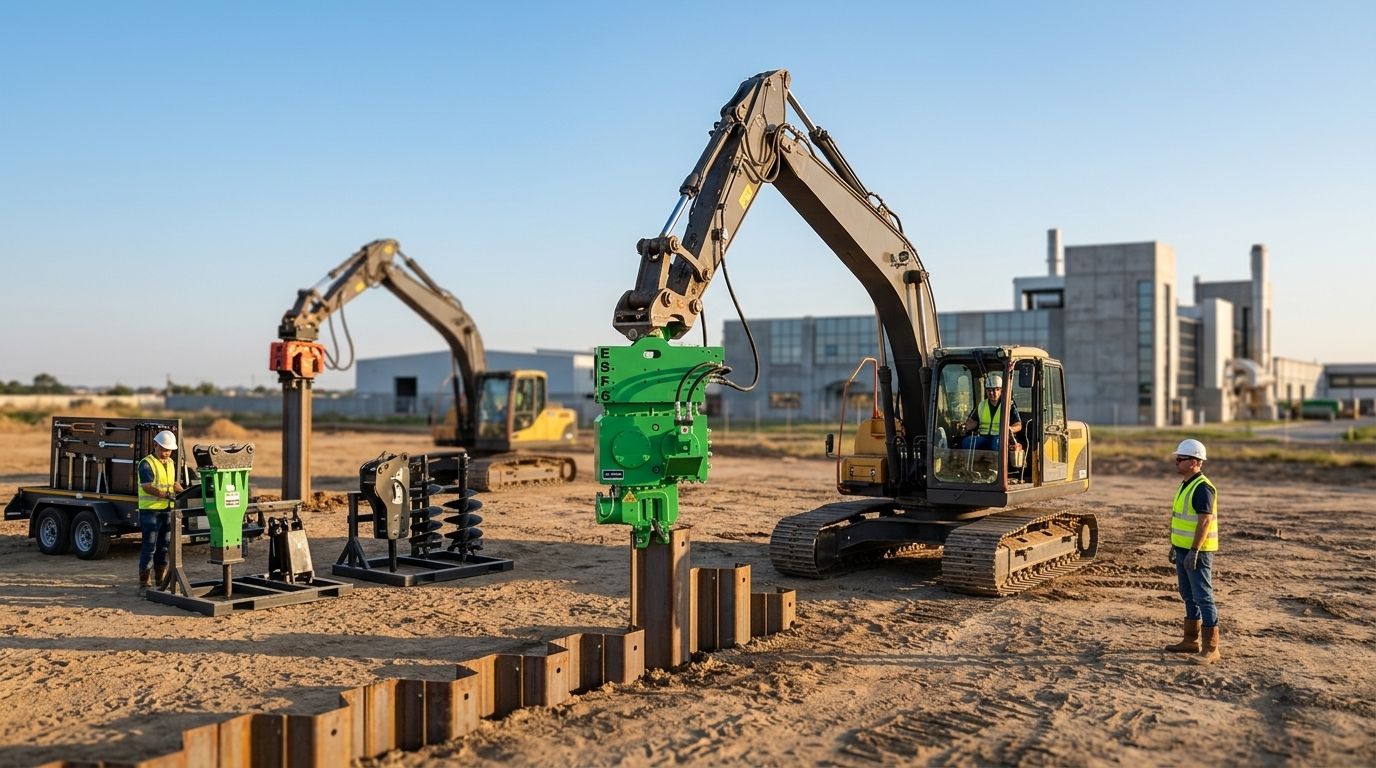
Choosing the right excavator pile driver attachment comes down to soil conditions, pile type, and carrier weight class — not just brand names. This guide ranks the main categories of excavator-mounted pile drivers for 2026 so you can match the right unit to the job before you call a dealer.
- IAI-USA hydraulic pile drivers win for contractors standardizing on one attachment fleet across excavator carriers in 2026.
- Vibratory pile driver attachments are the default choice for sheet piling in soft or saturated soil.
- Impact and drop hammer attachments still outperform vibratory units on H-beams, timber, and pre-cast concrete piles.
- Leader-mounted (mast-guided) pile drivers deliver the tightest vertical alignment on precision jobs.
- Mini-excavator compatible pile drivers are the only realistic option on tight-access residential and utility sites.
Why this matters
A pile driver attachment that doesn't match your excavator's hydraulic flow or carrier weight class either underperforms or burns out early. Buying the wrong category — vibratory instead of impact, or a full-size unit for a compact carrier — costs more in downtime than the attachment itself. International Attachments Inc. builds hydraulic attachments including pile drivers for exactly this kind of fleet-matching decision, and the categories below cover the real trade-offs contractors face going into 2026.
Best overall: IAI-USA hydraulic pile driver. Best for soft soil: vibratory pile driver attachments. Best for H-beam and timber piles: impact/drop hammer attachments. Best for precision alignment: leader-mounted pile drivers. Best budget/access option: mini-excavator compatible pile drivers.
What makes the best excavator pile driver attachment
- Carrier compatibility — weight class matched to the excavator, not oversized or undersized
- Hydraulic flow and pressure match — attachment specs aligned to the host machine's circuit
- Force output for soil type — vibratory frequency or impact energy suited to the ground you're driving into
- Mounting and quick-coupler fit — bolts onto existing coupler systems without custom brackets
- Duty cycle and maintenance access — how much continuous run time before service is needed
- Dealer and parts support — network coverage across the US and Canada for downtime repairs
At a glance
| Attachment type | Best for | Standout feature | Key limitation |
|---|---|---|---|
| IAI-USA hydraulic pile driver | Fleet standardization | Runs off existing excavator hydraulics | Full spec sheet requires a direct quote |
| Vibratory pile driver attachments | Sheet piling, soft/wet soil | Fast penetration, low noise vs. impact | Loses power in dense or rocky ground |
| Impact/drop hammer attachments | H-beams, timber, precast piles | High driving force per strike | Slower cycle time, more site noise |
| Leader-mounted pile drivers | Precision vertical alignment | Mast keeps pile plumb through the drive | Needs a dedicated leader rig or mast setup |
| Mini-excavator compatible drivers | Tight-access, residential/utility | Fits carriers under 10 tons | Limited to smaller pile diameters |
1. IAI-USA hydraulic pile driver: best for fleet standardization
International Attachments Inc. builds hydraulic pile drivers designed to bolt onto excavator carriers already running IAI hammers, shears, or pulverizers, so a contractor's crew works off one coupler and hose standard instead of juggling attachment brands. The unit draws power directly from the excavator's own hydraulic circuit rather than needing a separate power pack.
IAI-USA hydraulic pile driver pros:
- Fits into an existing IAI attachment fleet without new couplers
- Backed by a dealer and rental network across the US and Canada
- Sized across multiple carrier weight classes
IAI-USA hydraulic pile driver cons:
- Detailed vibratory force and frequency specs aren't published online — you need to contact IAI-USA for a spec sheet
- Best value shows up when you're already running other IAI attachments, not as a standalone first purchase
Best for: contractors and rental fleets standardizing attachments across multiple excavator carriers. Verdict: Buy if you're already running IAI equipment or building out a multi-attachment fleet for 2026.
2. Vibratory pile driver attachments: best for soft and saturated soil
Vibratory pile drivers use counter-rotating eccentric weights to shake a pile into the ground rather than pounding it, which works fastest in sand, clay, and saturated soils common on sheet-piling jobs. They generate less noise and less vibration transfer to nearby structures than impact hammers, which matters on urban and shoreline sites.
Vibratory pile driver pros:
- Faster cycle time than impact hammers in soft ground
- Lower noise output, better for sites near occupied buildings
- Less risk of pile head damage since there's no direct strike
Vibratory pile driver cons:
- Loses effectiveness once you hit dense, rocky, or highly compacted soil
- Not suited to timber piles that need a striking force to seat properly
Best for: sheet piling and soft-soil vertical piles. Verdict: Buy for wet or loose-soil jobsites; Skip on rocky or heavily compacted ground.
3. Impact/drop hammer attachments: best for H-beams and timber piles
Impact and drop hammer attachments deliver a direct striking force down the pile axis, which is still the standard method for driving steel H-beams, timber, and pre-cast concrete piles into resistant soil. Excavator-mounted versions replace the older crane-suspended drop hammer with a hydraulic ram cycling on the carrier's own boom.
Impact hammer pros:
- Drives dense soil and mixed-obstruction ground that vibratory units can't push through
- Works on the full range of pile materials: steel, timber, and precast concrete
- No separate crane rig needed once it's excavator-mounted
Impact hammer cons:
- Slower cycle time than vibratory driving on soft ground
- Higher noise and vibration transfer, a problem on occupied sites
- More wear on the pile head over repeated strikes
Best for: dense or mixed-soil sites driving steel, timber, or precast piles. Verdict: Buy for resistant ground; Hold if your soil report shows mostly soft or saturated conditions.
4. Leader-mounted pile drivers: best for precision vertical alignment
Leader-mounted, or mast-guided, pile driving attachments run the hammer or vibrator along a fixed mast rather than free-hanging off the excavator boom. That mast holds the pile plumb through the entire drive, which matters on jobs with tight tolerance requirements like foundation grids and bridge piers.
Leader-mounted pros:
- Highest alignment accuracy of any excavator-based pile driving method
- Reduces pile drift compared to boom-mounted free-hang systems
- Works with either vibratory or impact hammer heads on the same mast
Leader-mounted cons:
- Requires a dedicated leader/mast rig, which adds setup time and cost on top of the hammer itself
- Less mobile between pile locations than a straight boom-mounted unit
Best for: foundation grids, bridge piers, and any job with tight plumb tolerance. Verdict: Buy when alignment tolerance is the deciding factor; Skip for fast, loose-tolerance production driving.
5. Mini-excavator compatible pile drivers: best for tight-access sites
Compact pile driver attachments built for carriers under roughly 10 tons open up residential fencing, utility pole setting, and small-scale foundation work where a full-size excavator can't maneuver. They trade maximum driving force for the ability to work inside backyards, alleys, and narrow utility easements.
Mini-excavator pile driver pros:
- Fits sites a full-size carrier physically can't access
- Lower hydraulic flow requirement matches smaller machine circuits
- Faster mobilization for small, scattered jobs
Mini-excavator pile driver cons:
- Limited to smaller pile diameters and shallower drive depths
- Not a substitute for full-size units on commercial foundation work
Best for: residential fencing, utility poles, and confined-access jobsites. Verdict: Buy for small-carrier fleets running tight-access work in 2026.
How this was ranked
Each category was scored against the six criteria above: carrier fit, hydraulic match, force output for soil type, mounting compatibility, duty cycle, and dealer support. The order reflects which use case each attachment type wins outright, not a single overall winner across every job type.
Which excavator pile driver attachment should you choose?
For most contractors running a mixed fleet in 2026, the IAI-USA hydraulic pile driver is the safest default because it works off equipment you likely already own. If your soil report comes back soft or saturated, switch to a vibratory attachment. If you're driving steel or timber through resistant ground, an impact hammer is the only category that reliably gets the pile to depth.
“The soil report should pick your pile driver category before the carrier size does.”
FAQ
What's the best excavator pile driver attachment for 2026?
For fleets standardizing on one attachment brand, an IAI-USA hydraulic pile driver is the strongest default for 2026 because it runs off the excavator's existing hydraulic circuit. The right category still depends on soil type — vibratory for soft ground, impact for dense or mixed soil.
Is a vibratory hammer better than an impact hammer for pile driving?
Vibratory hammers drive faster and quieter in soft, sandy, or saturated soil, while impact hammers push through dense or rocky ground that vibratory units can't penetrate. The choice comes down to the soil report, not a general performance ranking.
Can a mini-excavator run a pile driver attachment?
Yes, mini-excavator compatible pile drivers are built for carriers under roughly 10 tons and match the lower hydraulic flow those machines produce. They handle smaller pile diameters and shallower drives than full-size attachments.
How much hydraulic flow does an excavator pile driver need?
Flow requirements vary by attachment size and carrier weight class, which is why matching hydraulic pressure and flow to the specific unit matters before purchase. Contact the manufacturer's dealer for the exact flow spec on a given model.
What's the difference between a leader-mounted and excavator-mounted pile driver?
A leader-mounted pile driver runs the hammer along a fixed mast that keeps the pile plumb through the drive, while a standard excavator-mounted unit hangs off the boom with less alignment control. Leader systems cost more setup time but win on precision jobs.
Do pile driver attachments work with any excavator brand?
Most hydraulic pile driver attachments are built around standard quick-coupler and weight-class systems, so they fit across excavator brands within the matching carrier size. Confirm the coupler and hydraulic spec with the attachment dealer before ordering.
How do I know what size pile driver attachment fits my excavator?
Match the attachment's rated carrier weight class to your excavator's operating weight, then confirm the hydraulic flow and pressure line up with the attachment's requirements. A dealer can verify fit against your specific carrier model.
Is renting or buying an excavator pile driver attachment better in 2026?
Renting makes sense for a single project or unfamiliar soil conditions, while buying pays off for contractors running repeat pile-driving work across multiple jobs. Rental and dealer networks for attachments like IAI-USA's pile drivers cover both options across the US and Canada.
One last thing
The most common failure on excavator pile driver jobs isn't the wrong hammer — it's a hydraulic flow mismatch between the attachment and the carrier, which shows up as overheating or a stalled cycle mid-drive. Confirm flow and pressure specs against your excavator before the attachment ever reaches the site, not after.